With Walt Whitman in Camden: A Digital Edition
Encoding Guidelines
Traubel Tags
Click on sample pages to view a larger version
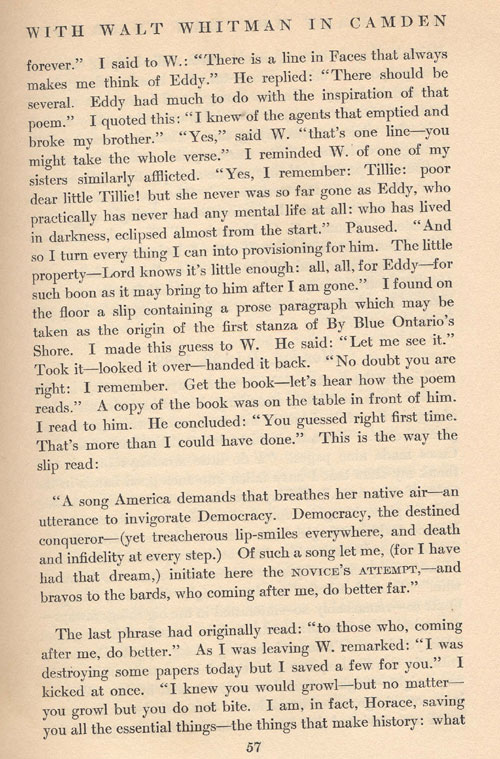
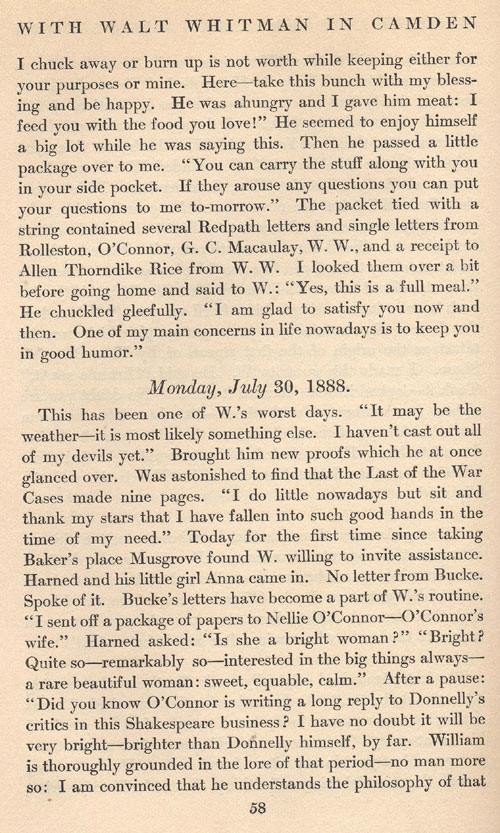
The Nature of the Text
We are marking up and editing the nine volumes of With Walt Whitman in Camden as a part of the Walt Whitman Archive, but there is a sense in which the text itself represents an archive. The copies of the book that we have (or the photocopies of the book that you have) already represent the selection, transcription and compilation of giant heap of documents; Traubel had pages and pages of transcribed conversations as well as an assortment of documents that he collected over time. These documents include letters, photographs, a copy of Whitman's will, scraps of paper with Whitman's writing on them, etc.
In another sense, the text is comprised of quotations, and itself represents an extended quotation. So the divisions in the tag library are fairly arbitrary, and arranged more for practical use. Structural elements include sessions, paragraphs, and page breaks, but it would be just as apt to chatacterize letters, figures and quotations as structural elements. Letters themselves are actually marked up as written quotations.
Read the pages on the right for a revealing conversation between Traubel and Whitman concerning the strange nature of this text. .
Tags, Spacing and Punctuation
As you transcribe and tag the text, be sure to watch spaces and record all punctuation marks. For example, a quotation should look like this: <q who="Walt Whitman">"quote."</q> The q tags do not insert quotation marks; they just indicate that the enclosed text is classified as a quotation. Notice that there is no space between the period, the closing quotation mark, and the closing tag. The next sentence should start two spaces after the closing tag. You want to be able to remove all of the tags and leave the text with consistent spacing. Spacing rules (so far), are as follows: two spaces after a period, one after a comma, one after colons and semicolons. The — and the & are treated under Special Characters.
Notes and Lists
You'll want to keep a file open in notetab exclusively for notes and questions.
You also need to keep a running list of anyone you attribute a quotation to, written or spoken, with the version/spelling of their name, so we can keep a list and avoid duplicates (for example, "Thomas Harned" and "Tom Harned" are the same person, and references to him need to be made uniform).
The last list is of any new tags that you create.